Specifications
- Size: 15" x 15" x 17"
- Flywheel Speed: 2000rpm
- Disk Capacity: 3
- Drivetrain: Holonomic X
- Motors: 8
- Competitions: 8
- Region rank: 11th
- World rank: 523rd
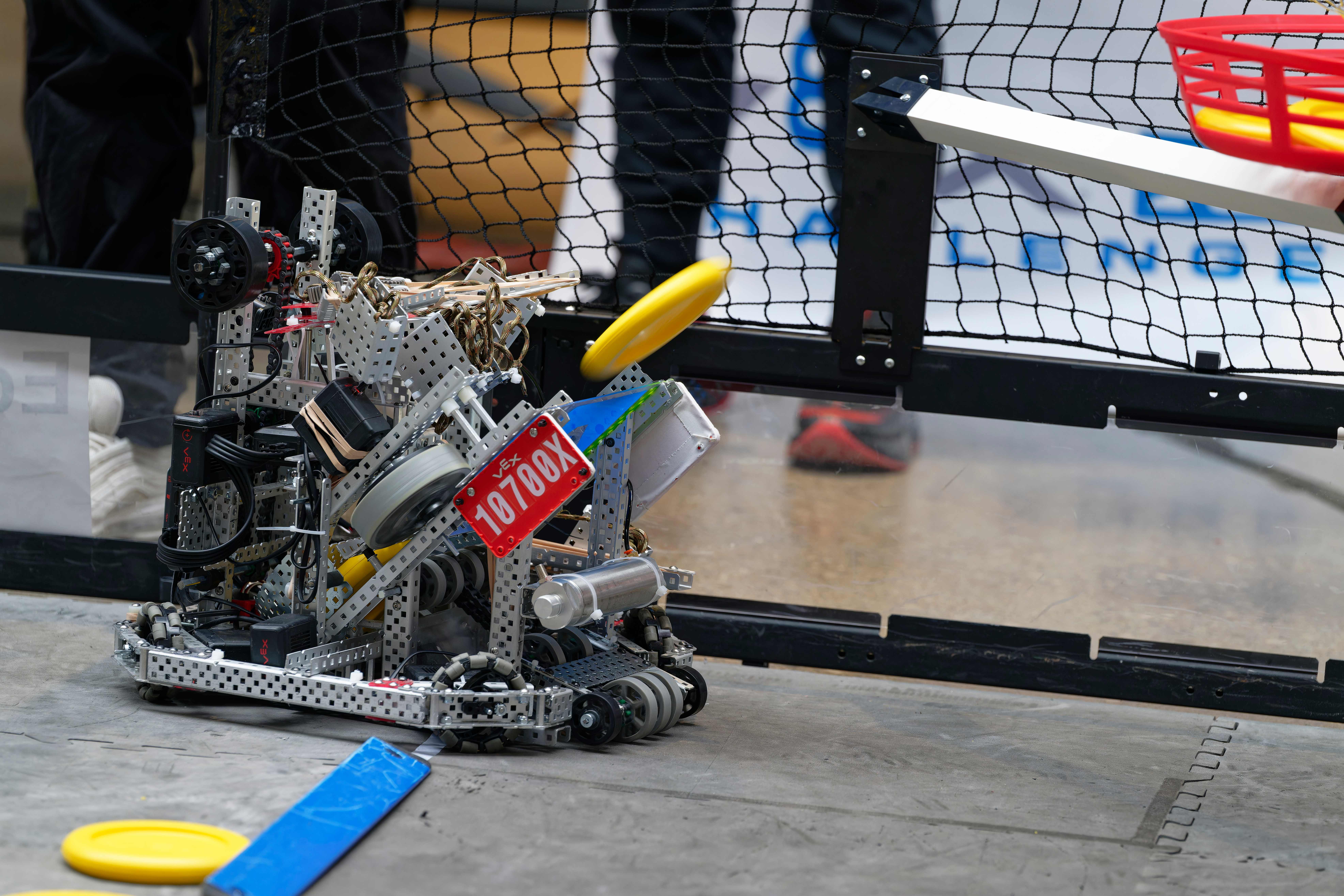
Bubbles, a robot that competed in the 2022-2023 season of the VEX Robotics Competition (VRC), was built for the fun of it.
Originally, I was a part of Viking Robotics, the robotics team of my high school when I was in grade 9, and it was going well, to the point that we qualified for the world competition in the USA, however, due to the COVID-19 outbreak getting to North America, we were no longer able to compete. During the quarantine period, I was hopeful that when the lockdown was released, I would be able to rejoin the team and continue where I had left off. This was until my final year of high school when I learned that there would no longer be a competitive robotics team at the school due to staffing reasons. Because of this, I took matters into my own hands.
The competition of the 2022-2023 season was to shoot a ~4” disk into a net similar to that of a frisbee golf net. Using the help of my family, I was able to find my team: 10700X aRTMech Robotics. Initially, it was difficult, since the season officially starts in April, the school year starts in September, and the team is being formed in late October, getting components was difficult, as most sources were sold out or back-ordered. The only raw material required for the robot was steel, which the robot had to be made out of for the first few competitions.
A concept that I had wanted to do for the robot was something called “X-drive”, where the wheels of the robot are all tilted 45° to allow the robot to strafe. This turned out to be an ongoing issue throughout the season, as due to the design, the robot was unable to be supported very well until later competitions, which due to the steel frame, would bend causing the robot to get bottomed out or not go as fast as it theoretically should due to axles grinding on parts they should not touch.
As a team with a very limited budget, as well as very few active members, the iteration process of the robot was not as streamlined as it should have been throughout the season, in which the robot would constantly be worked on between competitions without the design book being updated until the last minute, adding more stress onto the team.
Eventually, persevering the issues we faced, the robot was able to be rebuilt during the winter break using the proper materials to be what I had always envisioned; properly supported, in the correct manner of intaking and shooting, and more importantly VERY maneuverable, it became one of the most competitive robots in the region, sitting 11th out of ~120 teams in Ontario, and 500th in the world out of thousands of teams, letting us qualify for the regional tournament on skills alone.
During the provincial tournament, bubbles was one of the most consistent robots, winning 7 out of 8 of our qualification matches, leaving us 4th seed in the round of 16. Everything was going well until the round of 16, where the robot was put into an unforeseen failure mode where it could not move due to being bottomed out, with the match being determined by a controversial judge's decision, leading to us not making it further in the season.
Although the season ended abruptly, this project taught me how to use an iterative design process as well as how to compromise, be fluid, and work around problems.